
One of the most important young artists emerged in the international art scene since the last decade, Mircea Cantor (*1977, Romania) is best known for his use of video and mixed media installations to address the notions of displacement, uncertainty, fragility of convictions and uneasy confrontation of ideologies. The artist said at an interview that today “as we live in a simultaneous world where various items meet in the same place and time, there is a space of a beautiful tension that can lead toward a new vision”.
Adapting a highly economic language, the artist is far more optimistic than cynical with his art. A flying carpet with symbols of angels and airplanes is enough to bring different religions and values together. Despite being labeled as “provocative” from time to time, Mircea is in fact an idealist. A co-existed world in perfect harmony is perhaps not so unattainable in his eyes. “Le Monde” should be “Les Mondes” (2008). At least he has faith in Man. But he is not innocent; his innocence has purity at heart but wisdom in the mind.
Selina Ting, Sept 2011, Paris

Talking about his video Double Heads Matches (2002)which gained him attention, he said he was lucky to have met the Romanian manufacturer who found a crazy solution to produce 20,000 boxes of double-heads matches, legally against the EU law and technically impossible to do such a task. Mircea stressed the contrast in his cinematographic language, “you can see from the videos, they had to cut the wood into matchsticks,
and dipped both tips into phosphorusat and dried them in a special oven. I recorded the whole process step by step. The first part of the production was by machine, very systematic and mechanical, noisy. Then the second part is made by human hand which gives different motion, speed.” When the aggression of the machine is replaced by the warmth of the human hand, the images then speak of attention, passion and quietness.

Mircea is a vegetarian and he wants his food to be prepared with care and passion, which were obviously absent in the salad before him. Critical towards the mass-consumption and fast-food culture, he does not want to comply with the market’s expectation for the ever new and newer works. Instead, he integrates and juxtaposes his old works with newer pieces in his solo shows. In his installation piece, The Need for Uncertainty (2008), for example, where two peacocks (born and brought up in cages) were placed inside a gallery space in a series of golden cages, it becomes a symbol of our daily illusion of freewill as well as an artist’s self-reflexive questioning of his social role to perform, to produce and to please the public.
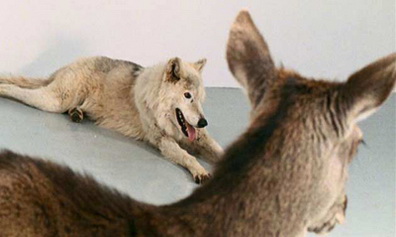
The use of animals in his work evoked some debates in different occasions. In an earlier much acclaimed video work, Deeparture (2005), a deer and a wolf were once again founded in an unsettling encounter inside a pristine white gallery space, what interests the artist is not scenes of bloodshed but a perpetual climax of “something-might-happen”, but then it would never happen. “It’s the power of the humanity, the ability to control. That’s why we are above other creatures, because we can control and sublimate the tension, turn it into something higher, let’s say love. But then the question is how.” The encounter of the wild and the civilized reflects back on us as a conscious contained subject.
The work that actually prompted me to call his gallery for an interview is a more recent signature work – his video Tracking Happiness (2009). It features a group of seven girls dressed in white walking in a circle while erasing the footprints on the sand of the person in front of her. The image is very simple, the atmosphere and the gestures speak of pureness. It’s a highly lyrical work that looks easy, perhaps too easy, for audience who knows Mircea’s work. But all these are just there to draw you into the mental state so that you can make conscious of what’s going on underneath the simplicity. For me, in terms of aesthetics, this is the most emblematic work that the artist produced in the last decade. It’s about happiness which is the very first
purpose of our life. But then where is happiness? Who is showing us the path to happiness? “Can someone really show you a direction to find happiness? I believe that happiness is only from you, you have to find it yourself. Nobody can give you direction. You can follow the footsteps of the person before you, but that doesn’t guarantee your own happiness. So when you erase someone’s footstep, it means that you start your life from zero, always, at every moment.” Agreed, but then why Tracking? “Tracking means this kind of blind pursuit, searching, thinking that by following something, you will reach it. So, from this point of view, the video is quite perverse. It’s about disillusion.”


Mircea Cantor uses all kind of media though video installation is the core. I am interested in how he decides which form to adopt for which work, after much request, he gave me an example of how he works – Shadow for a While (2007).
“Firstly, it was a shadow drawn on the wall in my studio. It stayed there for quite a moment. Then, I told myself, ‘you should burn it’. How? Burning needs the time element and time element is only provided by film. So, there it’s, the film. Otherwise, it would just be a banner, a shadow. It becomes much stronger and drew deeper in its symbolic meaning.”
The shadow, or the blackness, of the flag makes it an anonymous symbol for any country, and thus, universality. Why it’s burning? Is it about destruction? “What interests me isn’t the idea of destruction but the idea of suspension. It’s a place to speak about new possibilities, in the way that when you finished something, not necessarily something new will take place. It’s optimistic because you give a chance for something to develop, not just for the sake of destroying something.” The burning process itself can be short, but this short moment of ideological vacuum that we largely overlooked could be an important cool down period for new ideas to develop. A statement that many would still be overlooked, I believe.
About the artist
Mircea Cantor was born in Romania in 1977. Lives in Paris, Berlin and Romania
His major exhibitions include More Cheeks Than Slaps, Le Credac (France), 2011. Wise as a Serpent and Innocent as a Dove, Städtisches Museum Abteiberg, Monchengladbach, Germany, 2010. Mircea Cantor solo show, Kunsthaus Zürich, Zurich (2009), The need for uncertainty, Modern Art Oxford, Arnolfini, Bristol, and Camden Arts Centre, London, all in 2008; Ciel Variable, Fonds Régional d´Art Contemporain Champagne Ardennes – FRAC, France (2007); Airs de Paris, Centre Pompidou, Paris (2006); The title is the last thing, Philadelphia Museum of Art, USA (2006) and 4th Berlin Biennale (2004).


